
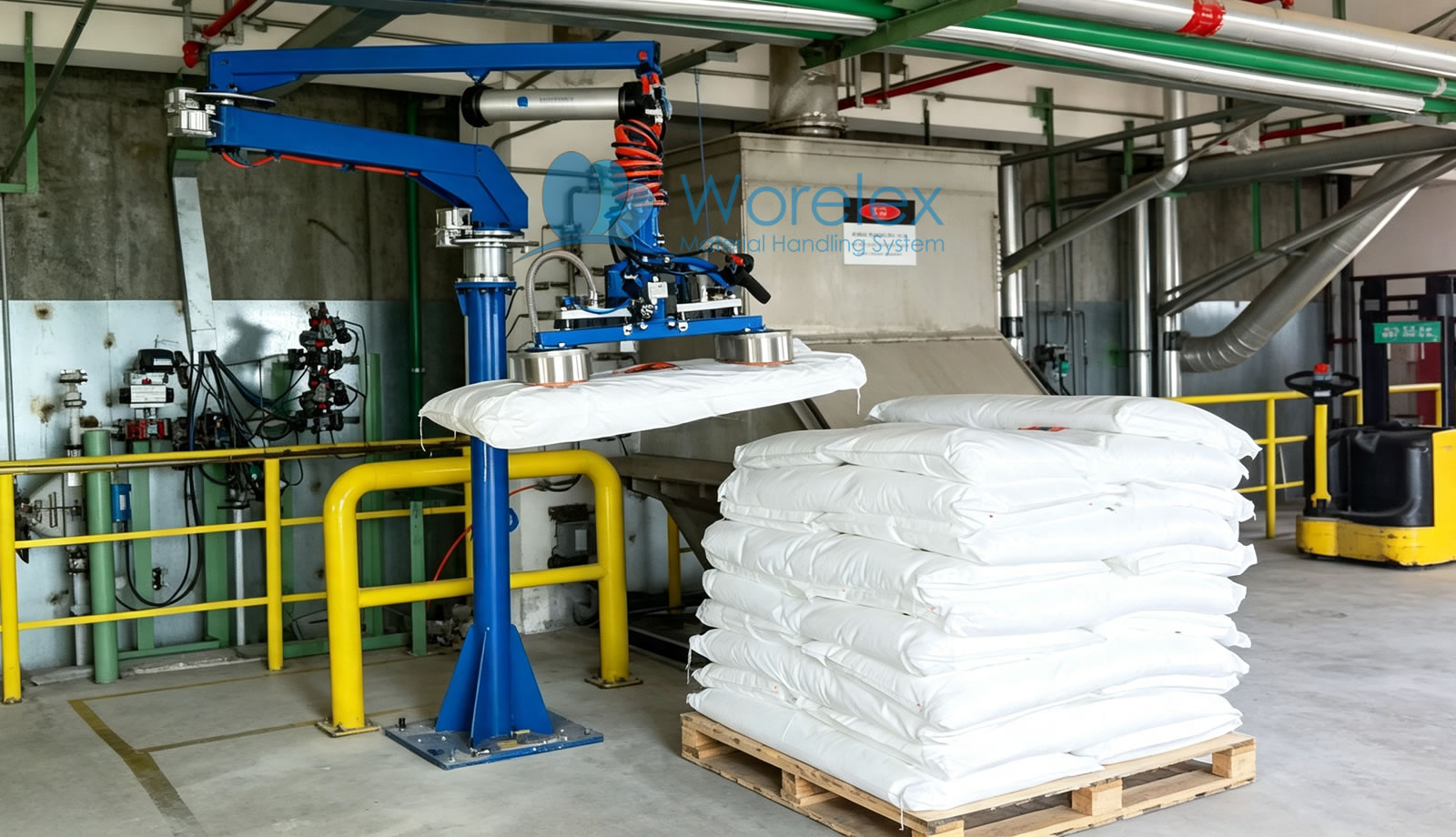
The handling and feeding of 50kg white sugar bags have always been a long-standing problem in the core ingredient process of dairy processing, which has been a major challenge for the workshop. Manual bending and lifting not only have high labor intensity and low efficiency, but also easily cause leakage and pollution, which does not meet the high cleanliness production standards of the dairy industry; Traditional mechanical fixtures are prone to packaging damage and increase production costs. The tracheal suction crane designed specifically for the food industry is becoming an efficient solution for dairy companies to solve this problem, achieving an integrated upgrade of safe, efficient, and compliant sugar feeding.
一、The core pain point of white sugar feeding in the dairy industry urgently needs technical breakthroughs
The hygiene, safety, and efficiency requirements for raw material handling in dairy production are strict, and the feeding process of 50kg sugar bags exposes three major industry pain points:
1. Dual bottleneck of manpower and efficiency: A single bag weighing 50kg requires 2-3 people to work together for transportation, and the efficiency of single person operation is extremely low, making it difficult to match the production line rhythm, resulting in a sudden increase in labor pressure during peak seasons. During the peak season of dairy production, production lines operate at full capacity, and the speed of raw material feeding directly determines production capacity. The inefficiency of manual handling often becomes a stumbling block to capacity improvement.
2. High hygiene and safety risks: Manual handling is prone to contamination, and workers' hands and clothing may carry bacteria and other pollutants, which can affect the hygiene of raw materials after coming into contact with sugar bags; Bending and lifting movements can easily cause work-related injuries such as lumbar muscle strain, and workers who have been engaged in this work for a long time have a high risk of occupational diseases. At the same time, the shaking of sugar bags during manual handling can easily cause dust to fly, affecting the cleanliness of the workshop and not meeting GMP/food SC standards, posing compliance risks to the enterprise.
3. Packaging loss and cost waste: Manual violent handling can easily cause damage and leakage of sugar bags, which not only wastes raw materials but also increases workshop cleaning costs; Traditional fixture squeezing can also lead to packaging damage, and in the long run, the cost of packaging loss remains high, bringing considerable economic burden to enterprises.
二、Tracheal suction crane: a precise solution for dairy sugar feeding
Tracheal suction crane (also known as vacuum suction crane) is based on the core principle of vacuum adsorption, and uses suction cups to generate negative pressure difference to achieve stable material adsorption. It is designed specifically for handling bagged materials and perfectly adapts to the feeding needs of 50kg white sugar bags in the dairy industry.
Core configuration adapted to dairy industry scenarios
Food grade safety materials: Made of 304 stainless steel columns, aluminum alloy cantilevers, and food grade silicone suction cups, these materials have no dead corners and are easy to clean, eliminating material contamination and meeting the requirements of high cleanliness workshops. Stainless steel and aluminum alloy materials are corrosion-resistant and easy to wipe, while silicone suction cups are soft and do not release harmful substances, ensuring the safety and hygiene of parts in contact with white sugar.
Flexible control design: The 270 ° rotating cantilever covers the entire row of trays and feeding ports. In the suspended assist mode, one hand can control the lifting, lowering, adsorption, and release, with light force positioning and precise feeding. Workers only need to gently operate the control lever to easily complete the handling and feeding of sugar bags, greatly reducing labor intensity.
Multiple safety guarantees: equipped with vacuum pressure gauge, gas cut-off protection, height limit, explosion-proof and anti-static functions, materials slowly descend when power is cut off, avoiding the risk of falling and adapting to dusty environments. The vacuum pressure gauge can display the vacuum level inside the suction cup in real time, ensuring stable suction force; The gas cut-off protection function can maintain a certain degree of vacuum for a certain period of time when the gas source is interrupted, preventing materials from falling; Explosion proof and anti-static design effectively avoids safety hazards in dusty environments.
Key advantages of adapting to sugar bags
Non destructive adsorption: The wide and high elastic suction cup gently adheres to the surface of the sugar bag, avoiding damage caused by claw squeezing, reducing the breakage rate by more than 90%, and significantly reducing packaging loss. The high elasticity of the suction cup can fit according to the shape of the sugar bag, without causing hard compression on the packaging, maximizing the protection of the integrity of the sugar bag.
Full bag compatibility: Supports various types of sugar bags such as woven bags and laminated bags, without the need to adjust fixtures. The same device can adapt to different packaging specifications. In actual production, the packaging of white sugar may vary depending on the supplier, and this feature of the tracheal suction crane greatly improves the versatility of the equipment.
Efficient and labor-saving: A single person can replace 2-3 people to complete the handling and feeding, increasing efficiency by 2.5-3 times. The entire process can be completed in 10 seconds per package, easily matching the production line rhythm. In dairy production, efficient raw material feeding is the key to ensuring smooth operation of the production line, and the efficient performance of the tracheal suction crane effectively solves the problem of low manual handling efficiency.